



History of education
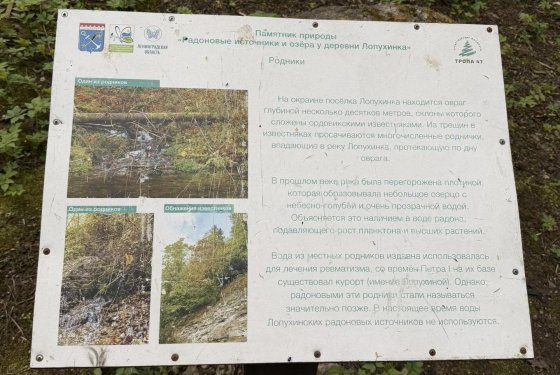
A complex of radon springs was formed in a canyon valley created by fused springs. Two dams were built in the upper reaches of the valley, which regulated the natural flow of springs and rivers. Two artificial reservoirs were formed above the dams: the Upper One (about 200 m long) and the Lower One (about 550 m long).
*** The name Lopukhinka comes from the Lopukhin brothers, who owned these lands in the XVIII century. In the 19th century, the estate was bought by P. H. Goering, who noticed the value of radon springs. He turned the area into a resort: he created a dam, a park, terraces and paths. Contemporaries compared Lopukhinka to "Swiss gardens," and the writer Nestor Kukolnik wrote about her as "Switzerland with groves and gardens hanging on rocks."
A hospital for sailors
*** In 1839, the governor of Kronstadt, F. F. Bellingshausen, and surgeon N. I. Pirogov rented the estate and opened a hospital for sailors here. The patients were treated for rheumatism with the help of radon springs. The results of water therapy were positive.
A 140—step stone staircase has been preserved from that time, a small but important historical detail.
The resort and its decline
*** In the 19th century Lopukhinka was a fashionable holiday destination due to its natural springs and well-kept park. The resort existed until 1885. After 1917, the Lopukhins' estate was turned over to a school, and today only ruins remain in its place.
Trout farming was organized below the lakes.
The status of a natural monument
In 1976, radon springs and lakes in the village of Lopukhinka received the status of a regional geological and hydrological natural monument. The area of the protected area was 270 hectares. The outlet points of the springs and the watercourse of the Lopukhinka River are protected on the territory of the monument.
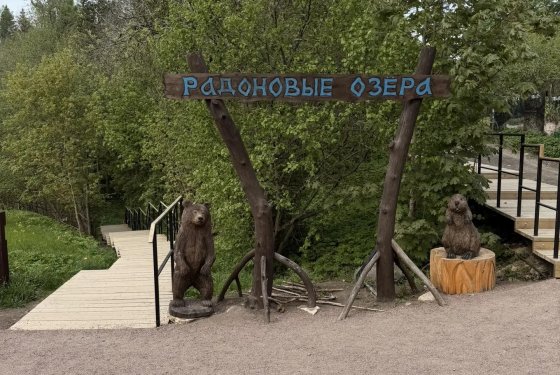
Today, an ecotrope runs around Lake Superior, at the beginning of which there is a small swimming pool.