
Creation history
Minich received the manor of Gostilitsy in 1731 as a reward from Empress Anna Ioannovna for his work on the construction of the Ladoga Canal. In Gostilitsy, he set up a country residence with a castle and developed his farm: he bred trout, set up mills.
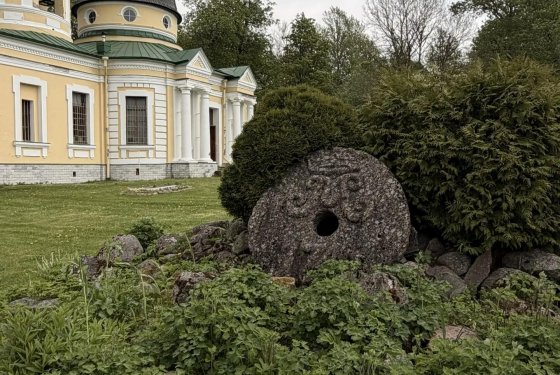
*** In the summer of 1741, on the second anniversary of the Battle of Stavuchany (where Minikh defeated the 90,000-strong Turkish army), he lowered a stone millstone to the bottom of the pond he created (now known as Minikh Pond). It depicted the count's crown, the monogram of Minich and the year 1741. This act was symbolic: Minich hoped that in the future the millstone would be removed from the pond, and people would remember him with kindness.
*** In the same year, 1741, Minich fell into disgrace under Elizabeth Petrovna: he was arrested, sentenced to death, but at the last moment the execution was replaced by exile to Siberia. Gostilitsy manor was confiscated.
The fate of the millstone
The millstone was removed from the pond a hundred years later, in the 1840s, when the pond was cleaned by the new owners of the estate, the Potemkins. After that, it was installed on the shore of the pond.
In the early 1920s, the millstone was still there, as Vera Mertens mentions in her memoirs. Later, he found himself at the bottom of the pond again — it is not known when or why.
In 1986, the millstone was discovered during the next cleaning of the pond. He was wheeled to the Southern Cavalier House, where there was a modest exposition dedicated to the history of the estate. After the fire, the millstone was left unattended, and for its safety, the rector of the Holy Trinity Church, Father Victorinus, moved it to the church building.
Modern location
Currently, the Minikhov millstone is located next to the Trinity Church in Gostilitsy.